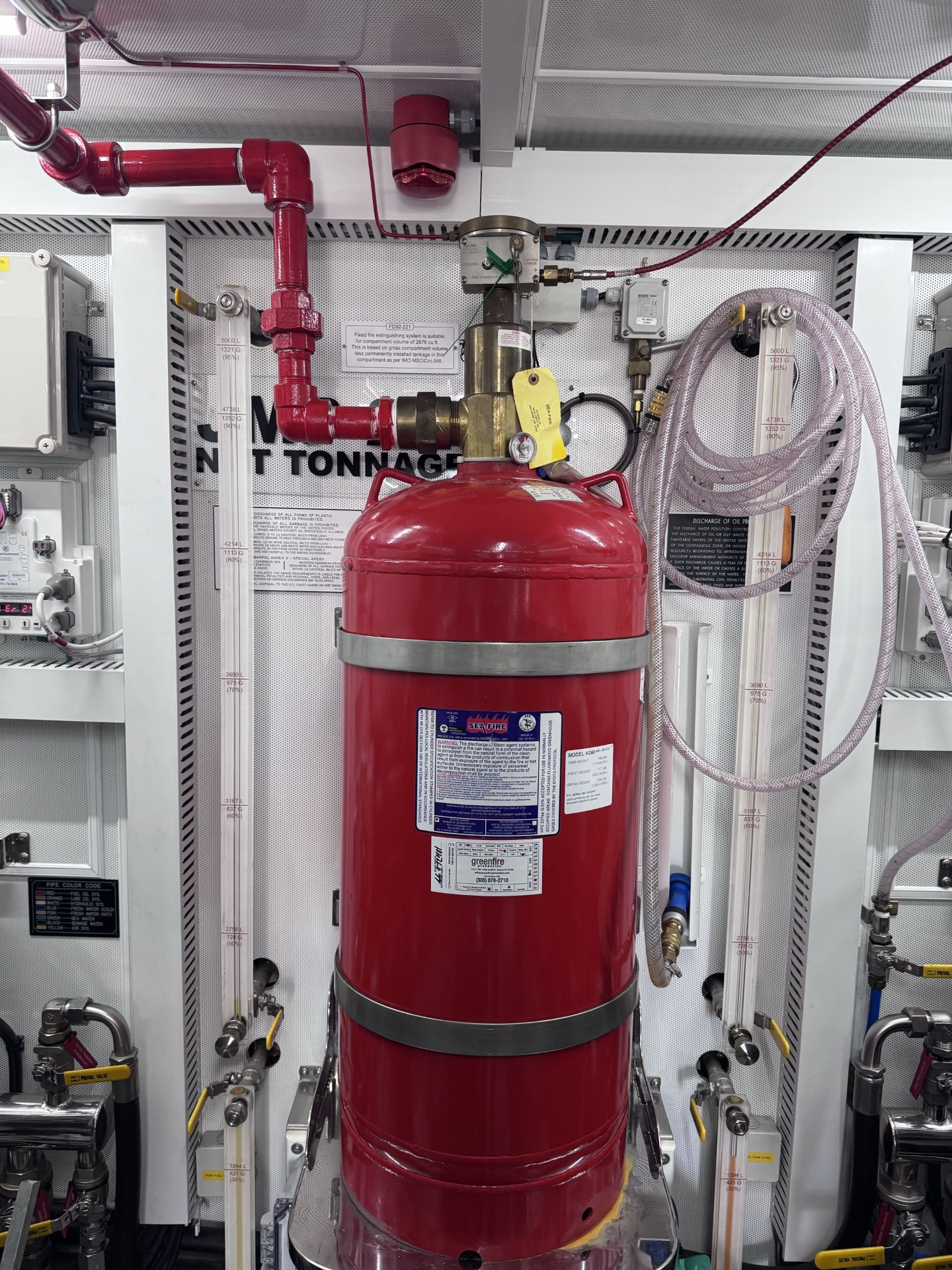
Marine fire suppression systems must be inspected annually by a qualified technician (USCG 46 CFR 34, NFPA 10, NFPA 2001). Cylinders require hydrostatic recertification every 12 years for fixed clean-agent and CO2 systems, and every 5 years for portable cylinders rebadged as fixed. After any discharge — accidental or actual — the system must be recharged, retested, and re-tagged before returning to service. Skipping the annual inspection invalidates insurance coverage and can result in a USCG no-sail order.
The short answer: annually, with key milestones
Every fixed marine fire suppression system needs a qualified-technician inspection every 12 months. On top of that, individual cylinders carry hydrostatic test cycles measured in years, and any discharge resets the clock entirely. Below is the full schedule.
Inspection schedule by system type
| System | Annual inspection | Hydrostatic test | After discharge |
|---|---|---|---|
| FM-200 (HFC-227ea) | Required | Every 12 yr | Full recharge + retest |
| Novec 1230 | Required | Every 12 yr | Full recharge + retest |
| CO2 (high-pressure) | Required | Every 12 yr (5 yr if stored >55 lb) | Full recharge + retest |
| Halon 1301 (legacy) | Required | Every 12 yr | Recharge if agent available |
| Portable extinguishers | Annual tag | Every 5 or 12 yr by class | Recharge or replace |
What USCG and NFPA actually require
Two regulatory frameworks apply in parallel. The USCG sets the minimum standard for vessel compliance under 46 CFR 34 (fire-extinguishing equipment) and Subchapters T and K for inspected vessels. NFPA 10 (portable extinguishers) and NFPA 2001 (clean agent) define the technical inspection methodology that surveyors and insurers expect.
- USCG: annual inspection by a 'qualified servicing facility' — typically interpreted as a marine-rated fire-protection company
- NFPA 2001 §7.3: visual inspection of every clean-agent cylinder twice yearly; full functional test annually
- NFPA 10 §7.3: dry-chemical extinguishers require internal examination every 6 years regardless of inspection
- ABYC A-4: recreational vessel guidance mirrors USCG commercial requirements as best practice
The hydrostatic test cycle explained
Hydrostatic testing pressurizes the cylinder shell to verify it can still safely hold its charge. Cylinders that fail are condemned — there is no repair. For most marine clean-agent and CO2 cylinders the cycle is 12 years from the manufacture date stamped on the cylinder shoulder.
A common mistake: assuming the inspection date resets the hydrostatic clock. It does not. The hydro date is tied to the cylinder, not the service. We coordinate hydro testing and provide loaner cylinders so your engine room is never without protection during the swap. See our suppression certification service for the end-to-end process.
What an annual inspection actually checks
- Cylinder weight verified against original charge — flagged if more than 5% loss
- Pressure gauge in the green operating band
- Discharge piping and nozzles inspected for corrosion, paint, or debris
- Manual pull station accessible and unobstructed
- Releasing circuit triggered in test mode — engine shutdown, blower kill, damper closure all confirmed
- Bottle mounting brackets and tamper seals verified
- Hydrostatic date checked; flagged 90 days before expiration
- USCG-compliant tag updated and signed
- Digital service record emailed to owner and captain within 24 hours
FM-200 vs Novec 1230 vs CO2: do the rules differ?
| Property | FM-200 | Novec 1230 | CO2 |
|---|---|---|---|
| Annual inspection | Yes | Yes | Yes |
| Hydrostatic | 12 yr | 12 yr | 12 yr (5 yr large) |
| Crew safe in space? | Yes (≤9% conc.) | Yes | No — evacuate first |
| Refill availability | Excellent | Excellent | Universal |
| Typical refill cost | $$ – $$$ | $$$ | $ |
The inspection requirements are identical across clean agents and CO2. The differences show up in operating procedures (CO2 requires evacuation alarms and time-delay) and in refill economics. If you are choosing a system or replacing one, see our buyer's-guide companion article.
What happens if you skip the annual?
- Insurance: most marine policies treat a lapsed certification as failure to maintain protective equipment, and will deny a fire-loss claim
- USCG: an inspected commercial vessel can be issued a no-sail order on the spot
- Charter: brokers and management companies refuse to list non-compliant vessels
- Resale: a missing service record can drop a survey grade and reduce sale price by 5–15%
After a discharge: what's required
Whether the discharge was accidental, a false alarm, or an actual fire, the system is out of service until it has been refilled, leak-tested, retested for releasing function, and re-tagged. Do not return the vessel to service in the interim — your fire protection is gone.
South Florida scheduling tips
Time your annual inspection 60–90 days before insurance renewal so any failures can be corrected before the policy needs the certificate. In the Florida Keys and on long-haul cruisers, schedule before May to avoid the hurricane-season backlog.
Why annual inspection beats reactive service
Most marine fire systems fail quietly. A slow valve leak drops cylinder pressure 1–2% per month — invisible without a weight check. A corroded releasing-circuit terminal looks fine until the day the engine-room thermometer trips and nothing fires. A blocked nozzle from old paint or insulation will pass a visual but not a flow test. The annual inspection is calibrated to catch all three before they become a discharged system or a fire loss.
We see this pattern every year: an owner skips a single annual to save $295, has a galley fire 18 months later, the FM-200 system fails to discharge because the releasing circuit drifted out of spec, and the insurer denies the claim citing the lapsed certification. The cost-benefit math is brutal — there is no version where skipping the annual saves money.
Choosing a qualified servicing facility
- Hands-on experience with the specific systems on your vessel (Sea-Fire, Fireboy-Xintex, Kidde, Amerex)
- USCG-recognized servicing facility status — verifiable through the facility's filing record
- Local agent inventory: FM-200, Novec 1230, CO2 stocked, not back-ordered
- Digital reporting workflow with same-day or 24-hour delivery
- Marine references in your county — South Florida marinas, charter operators, megayacht refit yards
Greenfire Marine services every major marine system and stocks agent locally. Read more on our About page or browse the full service catalogue in the services section.
South Florida county-by-county scheduling notes
Miami-Dade
Most Miami-Dade marinas (Dinner Key, Crandon, Haulover, Bayside) require the annual certification on file at the harbormaster before slip renewal. We file the PDF directly on request. Same-day availability is the norm — see Miami-Dade marine fire certification.
Broward
Fort Lauderdale marinas — Pier Sixty-Six, Bahia Mar, Las Olas, Lauderdale Marine Center — will suspend fueling and hot-work privileges if the suppression certification on file is more than 365 days old. Plan annuals 60 days ahead of any refit. See Broward marine fire certification.
Palm Beach
Rybovich, Old Port Cove, and Sailfish Marina pair the annual certification with a written hurricane-prep plan due May 31. Multi-zone fixed systems are common; budget for each zone as a separate inspection event. See Palm Beach marine fire certification.
Monroe County / Florida Keys
Keys vessels face NOAA sanctuary discharge rules on top of the USCG baseline. We run a regular Keys route — share the trip cost across multiple vessels the same day. See Monroe County marine fire certification.
Real-world example: 62 ft motoryacht, two-zone FM-200
February 2026, Pier Sixty-Six. Two FM-200 zones (engine room + lazarette), six portables, three smoke detectors, two CO detectors. Annual inspection found the engine-room cylinder 6% below original charge weight (slow leak past the valve stem — flagged for refill), the lazarette zone passing cleanly, and one portable bracket corroded at the bridge. Refilled the engine-room cylinder from local FM-200 stock, replaced the bracket, re-tagged everything. Total visit: 2 hours 10 minutes, $895 including agent refill. Vessel left the slip the same evening fully compliant.
Step-by-step: what an inspection actually looks like
- Pre-arrival: technician confirms vessel address, engine make, and system manufacturer to bring correct parts
- Cylinder weight verification with calibrated scale; flagged if more than 5% below charge
- Pressure gauge read against ambient temperature curve, not just the green band
- Manual pull station tested for free travel without firing the agent
- Releasing-circuit test in safe mode: engine shutdown, blower kill, damper closure all confirmed firing on signal
- Discharge piping and nozzles inspected end-to-end for corrosion, paint, or insulation contact
- Hydrostatic date stamped on the cylinder shoulder verified against the 12-year cycle
- USCG-compliant tag updated with technician signature and date
- Digital service report emailed within 24 hours; marina filing handled on request
Common failure modes by system age
| System age | Most common issue | Typical fix |
|---|---|---|
| 0–3 yr | Documentation only — sensor or bracket | Update tag, replace bracket |
| 3–6 yr | Slow valve leak, 1–2% cylinder loss / yr | Top-off refill |
| 6–9 yr | Releasing-circuit drift, blower-kill latch | Re-calibrate, replace relay |
| 9–12 yr | Approaching hydrostatic, nozzle corrosion | Hydro test, swap nozzles |
| 12+ yr | Hydro due, possible cylinder condemnation | Hydro or replace cylinder |
2026 NFPA 2001 update: what's new
The 2026 revision of NFPA 2001 tightens functional-test documentation for clean-agent systems. A simple cylinder weight slip no longer satisfies the standard — the test record must show the releasing-circuit firing, the engine shutdown firing, and the blower kill latching. We have updated our digital report templates to include all three signals as discrete line items so insurers and surveyors can verify at a glance.
Switching service providers mid-cycle
If you are leaving another shop, no penalty — we pick up the cycle from the last documented service date and continue from there. Bring the prior digital report or paper tag and we file forward. The hydrostatic clock is tied to the cylinder, not the shop, so nothing resets when you switch.
Annual vs semiannual: what owners and crew should do
The legal certification event is annual, but a smart vessel does not wait 12 months to look at the system. NFPA 2001 expects routine visual observation between technician visits, and South Florida conditions make that practical requirement even more important. Salt air, vibration, hot machinery spaces, and summer humidity can move a system from passing to questionable in a single season. The owner or captain should run a six-month visual check and log it, while the qualified technician performs the annual functional inspection and tag.
| Task | Owner / crew | Qualified technician |
|---|---|---|
| Cylinder visible and accessible | Monthly visual | Annual verification |
| Gauge / weight within tolerance | Visual only | Measured and recorded |
| Manual pull station unobstructed | Monthly visual | Annual functional check |
| Releasing circuit | Do not test live | Safe-mode functional test |
| Engine shutdown / blower kill | Observe condition | Annual signal verification |
| Tag and digital report | Keep onboard | Issue and file |
Manufacturer-specific notes for 2026 systems
Sea-Fire, Fireboy-Xintex, Kidde, and legacy Halon systems all follow the same annual compliance concept, but the parts and failure points differ. A technician who only knows building systems can miss marine-specific shutdown relays, helm indicators, and vibration-related piping issues. Greenfire Marine checks each system against the manufacturer label and the vessel installation, not against a generic building checklist.
| System family | 2026 inspection emphasis | Common South Florida issue |
|---|---|---|
| Sea-Fire FM-200 | Cylinder weight and helm indicator continuity | Slow valve leak after 6-8 years |
| Fireboy-Xintex clean agent | Manual pull cable travel and shutdown relay | Corroded cable end at engine-room bulkhead |
| Kidde CO2 | Cylinder date, horn/strobe, and discharge piping | Hydrostatic date missed during survey |
| Legacy Halon 1301 | Leak status and replacement plan | Agent cannot be economically refilled |
What happens if your certification expires?
An expired tag does not automatically mean the system is unsafe, but it does mean you cannot prove compliance. For private owners, the practical risk is insurance delay, failed pre-purchase survey, or marina slip-renewal friction. For charter and inspected vessels, the risk is higher: a no-sail order, suspended passenger operations, or a corrective-action deadline from the Coast Guard. If the tag is expired, schedule the annual inspection before moving the vessel for charter, sea trial, haul-out, or sale.
- Expired less than 30 days: book immediate annual inspection and keep the appointment confirmation onboard.
- Expired 30-180 days: expect a full functional test and closer review of cylinder weight history.
- Expired more than 180 days: treat it as a catch-up inspection; budget for batteries, relays, detectors, and possible hydrostatic testing.
- Expired during a sale or survey: ask for same-day digital documentation so closing is not held up by missing paperwork.
Cost expectations by system size
| Vessel / system | Annual inspection | Hydrostatic year |
|---|---|---|
| Single-zone FM-200 (40–55 ft) | $295 – $395 | +$385 fixed cyl |
| Two-zone FM-200 (55–80 ft) | $495 – $695 | +$385 per cyl |
| Multi-zone Novec (80–120 ft) | $795 – $1,400 | +$385 per cyl |
| Single-cyl CO2 (small vessel) | $295 – $395 | +$185 portable |
Full pricing context lives on our cost article and on the suppression certification service page.
Dockside marine fire certification across South Florida.
USCG & NFPA certified technicians. Same-day appointments available in most ZIPs. Bundle equipment + certification and save 15%.
Greenfire Marine has certified marine fire protection across South Florida since 2014. USCG and NFPA credentialed, fully insured, and trusted by captains from Miami to Key West. Read more about the team →
Frequently asked questions
How often does NFPA require fire suppression system inspection?+
NFPA 2001 (clean agent) and NFPA 10 (portable extinguishers) both require a full functional inspection every 12 months by a qualified technician, plus a visual inspection every 6 months by the owner or crew.
When does a CO2 cylinder need hydrostatic testing?+
Every 12 years for cylinders 55 lb or smaller, every 5 years for larger cylinders. The cycle starts from the manufacture date stamped on the cylinder shoulder.
Can I skip the inspection if my system has not been used?+
No. Inspection cycles are calendar-based, not usage-based. Cylinders lose pressure to slow leaks, brackets corrode, and releasing circuits drift out of spec regardless of whether the system has discharged.
Is FM-200 still legal in 2026?+
Yes. FM-200 (HFC-227ea) remains legal for marine use under EPA SNAP. Novec 1230 has lower global-warming potential and is becoming the preferred new-build choice, but existing FM-200 systems may continue to be serviced and refilled.
Who is qualified to inspect a marine suppression system?+
A qualified marine fire technician experienced with the specific system on your vessel (Sea-Fire, Fireboy-Xintex, Kidde) and licensed to handle the agent. Greenfire Marine services all major marine systems.