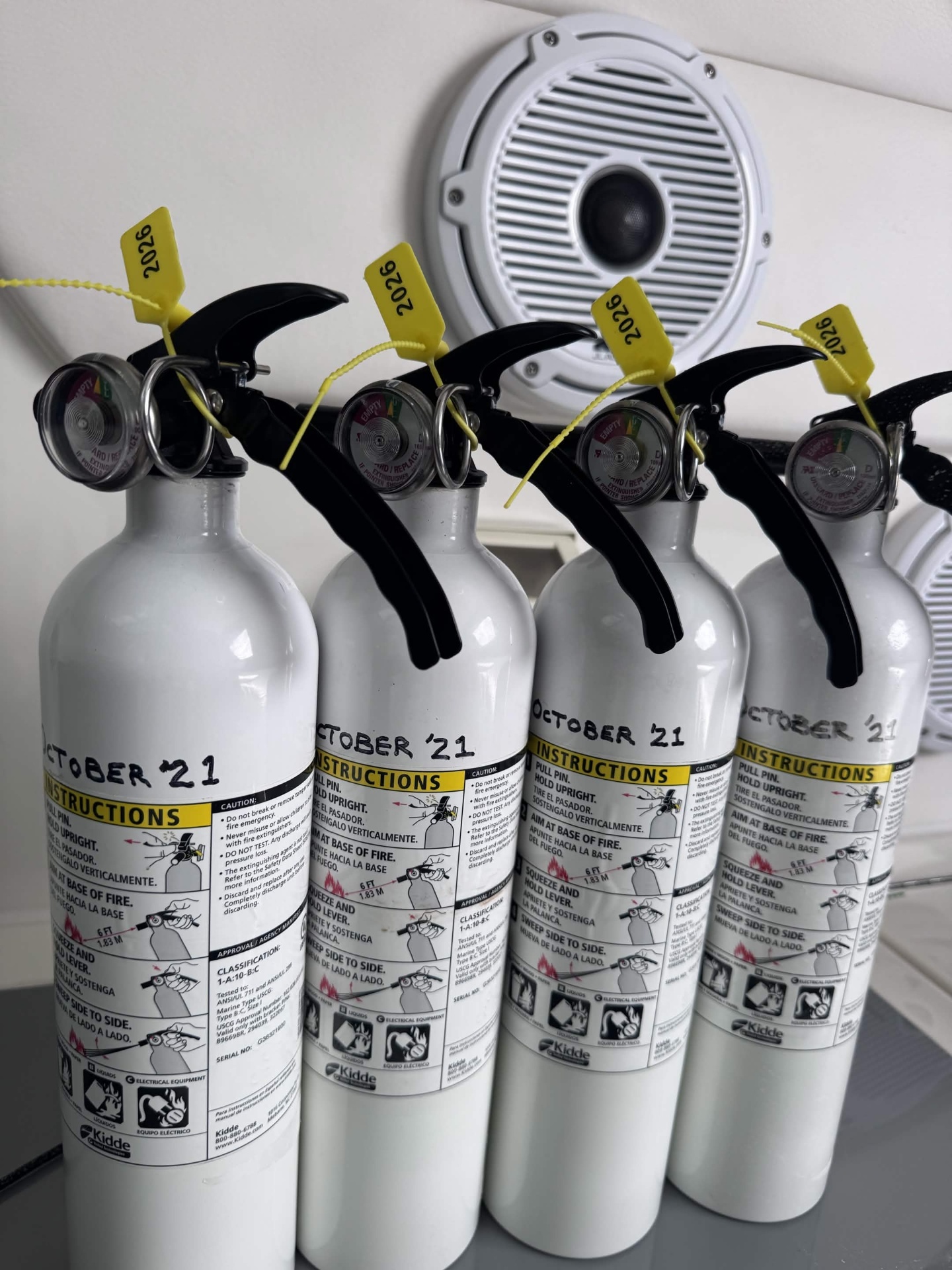
The best marine fire extinguisher for most yachts in 2026 is a 10 lb ABC dry-chemical unit with a marine-rated UL listing and a stainless or polymer wall bracket — backed up by Halotron 1 in clean engine spaces and CO2 at the galley. Look for a UL marine rating, a corrosion-resistant valve assembly, an aluminum or composite shell, and a tag from a certified servicing facility. Avoid generic big-box extinguishers without a USCG type approval letter.
What 'marine-rated' actually means
A marine-rated extinguisher is built to survive salt air, vibration, and constant humidity without failing its annual inspection. The label must show a UL marine listing (not just UL), a USCG type-approval number, and a manufacture date within the last 12 years. Generic household extinguishers will rust through their valve assembly inside 18 months on the water.
Quick comparison: ABC vs Halotron vs CO2
| Type | Best for | Pros | Cons | Refill |
|---|---|---|---|---|
| ABC dry chemical | General-purpose, helm, cabin, dock locker | Cheapest, widest fire class coverage (A/B/C) | Powder is corrosive — ruins electronics | $ |
| Halotron 1 | Engine room backup, electronics bay, helm | Clean discharge — no residue, safe on electronics | More expensive, slightly heavier per rating | $$ |
| CO2 | Galley, electrical panel | No residue, smothers fast | Discharge is loud and cold; not for confined spaces with crew | $ |
| Foam (AFFF / fluorine-free) | Fuel-tank deck spills | Excellent on liquid fires | Heavy, requires post-discharge cleanup | $$ |
How to read the label
- UL marine listing line (e.g. 'UL Listed Marine Type'). Generic UL is not the same.
- USCG type-approval number — usually formatted '162.028/EX####' for portable extinguishers
- Rating (e.g. 5-B:C, 10-B:C, 1-A:10-B:C) — bigger numbers mean longer effective discharge
- Manufacture date stamped on the cylinder bottom — extinguisher life is generally 12 years from this date
- Operating temperature range — must include 0°F if the boat ever winters north of the Carolinas
Top picks for 2026
Best overall: 10 lb ABC marine-rated
Highest USCG rating in a portable form factor, fits standard wall brackets, and the cheapest to certify annually. This is what we install on 80% of South Florida yachts. See the 10 lb ABC Marine Rated extinguisher in our shop.
Best for engine rooms: Halotron 1
Halotron leaves no residue, so your engines, electronics, and harnesses are not destroyed in the cleanup. Pair with a fixed clean-agent system as a manual backup at the engine-room hatch.
Best for galleys: 5 lb CO2
Stovetop oil and electrical fires don't tolerate water or dry chemical well. CO2 smothers fast and leaves nothing behind. Mount on the bulkhead beside the galley exit, not behind the stove where you cannot reach it during a fire.
Best fixed-system pairing: FM-200 or Novec 1230
Portable extinguishers cover the bridge and cabins; the engine room needs a fixed system. The FM-200 Clean Agent Marine Suppression System is our most-installed engine-room solution.
How many do you need?
USCG minimums depend on vessel length and whether you have a fixed system in the engine room. The minimums are a floor, not a target — most surveyors and insurers expect one extinguisher per major compartment plus a spare at the helm.
| Length | Minimum (no fixed system) | Recommended |
|---|---|---|
| Under 26 ft | 1 B-I | 1 ABC + 1 CO2 |
| 26–40 ft | 2 B-I or 1 B-II | 2 ABC + 1 Halotron + 1 CO2 |
| 40–65 ft | 3 B-I or 1 B-I + 1 B-II | 3 ABC + 2 Halotron + 1 CO2 |
| Over 65 ft | Per Subchapter T | 1 per cabin + 2 helm + galley CO2 |
Mounting and brackets — the silent failure point
The bracket fails before the extinguisher does. Steel brackets corrode in 12–18 months on the water; the screws lose grip in marine plywood; and a loose extinguisher rolling in a locker is grounds for a USCG citation. Spec stainless or marine-grade polymer brackets, and through-bolt to a backing plate where possible.
- Stainless 316 vehicle-style brackets for engine rooms
- UV-stabilized polymer brackets for sun-exposed deck lockers
- Quick-release strap brackets at the helm — speed matters more than security at the helm station
- Never zip-tie an extinguisher to a rail. It is a fail every time.
Certification tips for buyers
- Buy from a dealer who can certify on the same visit — cheaper than buying online and paying separately for certification
- Verify the manufacture date is current; old stock with a 5-year-old date loses 5 years of useful life
- Ask for a written quote that includes the first-year tag
- Bundle with annual certification to lock in 15% off — see our shop for current bundle pricing
What to avoid
- Big-box household extinguishers — they will fail their first marine inspection
- Plastic-bottom 'ultralight' extinguishers — the bottom cracks at the first hard sea
- Halon 1211 (banned for new sale since 1994) — legacy units may be re-tagged but not refilled
- Cheap import brands without a USCG type-approval number on the label
Local notes for South Florida buyers
Salt-air corrosion is roughly 3× faster in South Florida than in the Great Lakes. Inspect mounting brackets every 6 months, not 12, and budget for early replacement. We deliver and install across Miami-Dade, Broward, Palm Beach, and Monroe County.
Salt-air durability — what actually holds up
Three years dockside on Biscayne Bay or in Fort Lauderdale will destroy a generic household extinguisher's valve assembly and corrode its mounting bracket beyond use. Marine-rated units paired with stainless or polymer brackets last the full 12-year manufacture rating. The materials that survive: 316 stainless steel for brackets and screws, anodized aluminum or composite for cylinders, brass valve internals, and EPDM hose. The materials that fail fast: zinc-plated steel, plain aluminum brackets, carbon-steel screws.
- 316 stainless brackets through-bolted to a backing plate — 10+ year service life
- Polymer brackets with UV stabilizer for sun-exposed deck lockers
- Quick-release strap brackets at the helm and galley exit
- Tamper seals inspected every 6 months — salt-air degrades them faster than the unit itself
Pairing portables with your fixed system
Portables are the primary tool for cabin and helm fires; the fixed engine-room system is the primary tool for the engine compartment. The two should be coordinated, not duplicated. We typically install a Halotron portable at the engine-room hatch as the manual backup to a clean-agent fixed system — same chemistry family, no agent conflict if both discharge.
If your fixed system is older Halon 1301, do not assume it is still serviceable. Halon 1301 is no longer manufactured; existing systems may be re-tagged but cannot be refilled. Plan for a clean-agent conversion at the next major refit. See our FM-200 Clean Agent Marine Suppression System for the most common drop-in replacement.
Best by vessel type — a quick playbook
| Vessel | Helm | Galley | Engine room | Cabin |
|---|---|---|---|---|
| Center console (under 26 ft) | 5 lb ABC | — | 1 ABC at console | — |
| Express cruiser (26–40 ft) | 5 lb ABC | 5 lb CO2 | 10 lb ABC + Halotron backup | 5 lb ABC |
| Sportfish (40–65 ft) | 10 lb ABC | 5 lb CO2 | Fixed FM-200 + Halotron portable | 5 lb ABC each cabin |
| Motoryacht (65 ft+) | 2× 10 lb ABC | 5 lb CO2 | Multi-zone fixed + Halotron | 5 lb ABC per stateroom |
| Charter / dive boat | 10 lb ABC | 5 lb CO2 | Fixed + Halotron, per Subchapter T | Per crew + passenger count |
Engine-room strategy: portables that complement the fixed system
The fixed clean-agent system is the primary defense in the engine room. A Halotron 1 portable mounted at the engine-room hatch is the manual backup — same chemistry family, no agent conflict if both discharge, no residue to wreck the engines or harnesses after the event. Do not stage dry-chemical at the engine-room entrance: the cleanup after a discharge can total the engines.
Galley strategy: CO2 and a fire blanket, not foam
Galley fires are usually stovetop oil or electrical. CO2 smothers fast, leaves nothing behind, and is safe on electronics. Pair with a wool fire blanket in a quick-release pouch beside the stove for grease-pan fires. Foam and dry-chemical both make the cleanup worse than the fire.
Helm and bridge: speed beats security
The helm extinguisher needs to come out of the bracket in under three seconds. Use a quick-release strap bracket, mount within arm's reach of the wheel, and never tuck it under the console where you cannot see it. A 10 lb ABC at the helm is the standard — Halotron is the upgrade if your electronics rack is at the helm too.
Side-by-side: top-rated marine extinguishers in 2026
| Model | Type | Rating | Best use | Approx price |
|---|---|---|---|---|
| Kidde Mariner 110 | ABC | 1A:10B:C | General purpose | $45 – $65 |
| Amerex B402 | ABC 5 lb | 3A:40B:C | Helm, cabin | $65 – $95 |
| Amerex B441 (10 lb) | ABC 10 lb | 4A:80B:C | Engine room | $110 – $145 |
| Buckeye Halotron 5 lb | Halotron 1 | 2A:10B:C | Engine room backup | $295 – $385 |
| Amerex B570 (5 lb CO2) | CO2 | 5B:C | Galley, electrical | $145 – $195 |
| Fireboy-Xintex FE-241 fixed | Clean agent fixed | Engine room | Engine compartment | $1,200 – $2,800 |
County buying notes for South Florida
Most of our Miami-Dade and Broward clients buy the 10 lb ABC + 5 lb CO2 + Halotron 1 combo because it covers helm, galley, and engine-room backup without overlapping the fixed system. Palm Beach megayacht owners typically spec one extinguisher per stateroom on top of the fixed system. Florida Keys vessels need extra attention to bracket corrosion — replace stainless screws every 24 months, not 36.
Real-world purchase: 44 ft sportfish, full kit
April 2026, Lighthouse Point. Owner needed to outfit a freshly purchased 44 ft sportfish before insurance binder went live. We delivered and installed: 2× 10 lb ABC (helm + saloon), 1× 5 lb Halotron (engine-room hatch), 1× 5 lb CO2 (galley), 4 stainless 316 brackets through-bolted, plus the first-year certification tag on every unit. Total kit including install and certification: $895. Insurance binder approved the next day with the digital report attached.
Replacement cycle — when to retire, when to refill
- Refill: gauge in the recharge zone, unit has discharged, recharge after 6-year dry chemical agent expiration
- Hydrostatic test: 5 years for portables, 12 years for fixed cylinders
- Retire: 12 years from the manufacture date, visible corrosion on the shell, valve assembly seized, cylinder fails hydro
- Upgrade: switching from Halon to clean-agent fixed system, swapping dry-chemical engine-room portables for Halotron
How to choose the right rating, not just the right size
Buyers often compare extinguishers by pounds, but the rating on the label matters more than the cylinder weight. A 5 lb unit from one manufacturer can carry a materially different fire rating than a similar-looking unit from another. For yachts, the best choice balances rating, reach time, mounting location, agent cleanup, and the type of fire most likely in that compartment. The goal is not to place the biggest cylinder everywhere; it is to place the correct agent where a crew member can reach it within seconds.
| Location | Primary risk | Best 2026 choice | Avoid |
|---|---|---|---|
| Helm / bridge | Electrical and upholstery | 5-10 lb ABC or Halotron if electronics-dense | Tiny automotive cans |
| Galley | Grease, appliance, electrical | 5 lb CO2 plus fire blanket | Foam above cooktop |
| Engine-room hatch | Fuel and electrical | Halotron backup to fixed clean-agent system | Dry chemical unless no alternative |
| Cabins | Textiles and chargers | 5 lb ABC in visible bracket | Loose extinguisher in locker |
| Lazarette | Batteries, inverter, shore power | ABC or clean agent based on equipment | Unrated household unit |
Cleanup cost matters after a discharge
The cheapest extinguisher is not always the cheapest incident. Dry chemical works, but its powder is corrosive and invasive; it can travel through engine-room airflow, electronics cabinets, and upholstery seams. Halotron and CO2 cost more upfront, yet they can save thousands after a small electrical or engine-room event because they leave little to no residue. That is why we recommend dry chemical for general life-safety coverage and clean agent for high-value machinery or electronics spaces.
| Agent | Typical cleanup burden | Best economic use |
|---|---|---|
| ABC dry chemical | High: vacuum, corrosion control, electronics risk | Cabin, helm, general emergency |
| Halotron 1 | Low: ventilate and inspect | Engine hatch, electronics, tender garage |
| CO2 | Very low: ventilate, check oxygen safety | Galley and electrical panels |
| Foam | Medium: wet cleanup and runoff control | Fuel spill response where allowed |
Installation details that separate yacht-grade equipment from commodity gear
- The bracket is through-bolted or mounted into structural backing, not just screwed into a thin liner.
- The cylinder can be removed one-handed in less than three seconds.
- The label, gauge, and tag face outward so a captain or inspector can read them without removing the unit.
- No extinguisher is mounted where a fire would block access to it, especially behind galley appliances or inside engine-room doors.
- Salt-exposed mounts use 316 stainless hardware or UV-stabilized polymer, not painted mild steel.
- The installation includes first-year certification, so the purchase is compliant immediately rather than just delivered.
Shop bundles and certification
Buying new equipment? Bundle the first-year certification on the same visit and save 15%. We carry the 10 lb ABC Marine Rated, FM-200 Clean Agent Marine Suppression System, and full Fireboy-Xintex detector range. Browse the full shop for current stock.
Certificación marítima contra incendios en muelle en todo el Sur de Florida.
Técnicos certificados USCG y NFPA. Citas el mismo día disponibles en la mayoría de los códigos postales. Combine equipos + certificación y ahorre 15%.
Greenfire Marine ha certificado protección marítima contra incendios en el Sur de Florida desde 2014. Acreditados USCG y NFPA, totalmente asegurados y de confianza para capitanes desde Miami hasta Key West. Conozca más sobre el equipo →
Preguntas frecuentes
Are household ABC extinguishers OK for boats?+
No. Household extinguishers are not built for salt air and do not carry the UL marine listing or USCG type approval that surveyors require. They will fail an annual inspection.
How long does a marine extinguisher last?+
Generally 12 years from the manufacture date stamped on the cylinder, with annual inspections and a hydrostatic test at the 5- or 12-year mark depending on class.
Halotron vs FE-36 — which is better for engine rooms?+
Both are clean agents safe on electronics. Halotron 1 has wider availability and better refill economics in South Florida. FE-36 has slightly better cold-temperature performance, which rarely matters here.
Where should the galley extinguisher go?+
On the bulkhead beside the galley exit, mounted between waist and shoulder height. Never behind the stove or above the cooktop — you cannot reach a burning extinguisher.
Can I buy and install extinguishers myself?+
Yes, but the first-year certification tag must come from a qualified servicing facility. Bundling purchase and certification in one visit usually costs less than the two services separately.